
Careers in Game Design and Animation
Games, animation, VFX and the booming creative technology industry, and what it really takes to build a career in it.
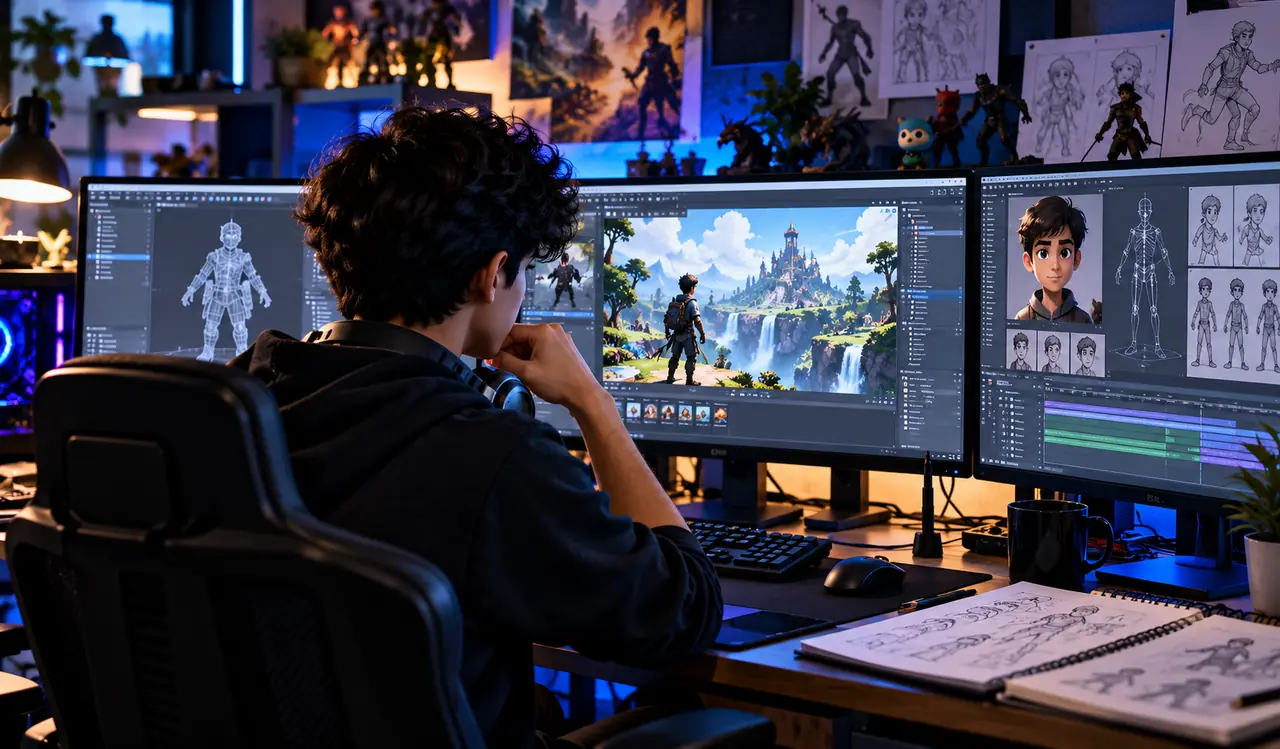
Many students spend hours playing games and watching animated films. Some start wondering: could I make these for a living? The answer is yes. Game design, animation and visual effects (VFX) are real, growing careers, and India's creative technology industry is expanding, both for Indian audiences and for global studios.
But there's an important difference between enjoying games and animation and creating them. This guide explains the careers, the skills they really require and the education routes, so students and parents can make an informed decision.
What does the creative technology industry include?
This sector is often called AVGC: Animation, Visual Effects, Gaming and Comics. It also increasingly includes extended reality (XR), such as virtual and augmented reality. Work ranges from mobile and console games to animated films, series, advertisements, film VFX and educational content.
What are the main career paths?
| Role | What they do |
|---|---|
| Game designer | Creates game rules, mechanics, levels and player experience |
| Game developer or programmer | Writes the code that makes games work, often using game engines |
| 3D artist and modeller | Creates characters, environments and objects in 3D |
| 2D or 3D animator | Brings characters and objects to life through movement |
| VFX artist | Creates visual effects for films, series and advertisements |
| Concept artist and illustrator | Designs the look of characters, worlds and scenes |
| UI and UX designer | Designs menus, screens and how players interact with the game |
| Game writer | Writes stories, dialogue and worlds for games |
| QA tester | Tests games to find bugs and improve quality |
Notice that the field needs both artists and programmers, as well as writers and designers. There's room for many kinds of talent.
What skills do you need?
For creative roles
- Drawing, sketching and a strong visual sense
- 2D and 3D design and animation software
- Storytelling and understanding of movement, colour and composition
For technical roles
- Programming, commonly C++, C# or Python
- Game engines and Maths, especially geometry and physics
- Logical problem-solving
For everyone
- Creativity, teamwork and patience with detailed, repeated work
- Accepting feedback and revising work many times
- A strong portfolio showing your best work
These careers suit students with strong creative and spatial aptitude for art roles, or logical aptitude for programming roles.
Playing vs making: an honest reality check
For more on the difference between enjoying something and making a career from it, read how interests affect career choices and should you choose a career based on your passion?
What is the education pathway?
In school (Classes 9 to 12)
- Any stream can lead to creative roles in animation and design
- PCM with Computer Science is best for game programming
- Start creating now: try beginner game engines, free animation software or digital drawing
- Join game jams, animation contests or art competitions, and start a portfolio
After Class 12
- B.Des in animation, game design or communication design, through design entrance exams such as UCEED and NID DAT
- B.Sc. or BA in animation, VFX, game design or multimedia
- B.Tech or BCA in Computer Science for game development and programming
- BFA for strong foundations in fine art and illustration
After graduation
A master's in game design, animation or interactive media can help, but in this field your portfolio and skills usually matter more than your degree. Keep building projects throughout your studies.
Is this a good career for the future?
Gaming, animation and VFX continue to grow globally, and India is becoming an important hub for creative technology work. New areas like virtual reality, educational games and AR experiences are adding opportunities. AI tools are changing some tasks, so artists and developers who combine creativity, strong fundamentals and new tools are likely to be in the best position.
Is game design or animation right for you?
It may suit you if you love creating, not just consuming, games and animation; if you're willing to practise consistently; and if you enjoy teamwork and feedback. A psychometric career assessment can show whether your aptitude leans more towards the artistic or technical side of the industry.
Summary
Game design, animation and VFX offer creative and technical careers, from game designers, programmers and 3D artists to animators and VFX artists. Creative roles are open to any stream, while programming roles suit PCM with Computer Science. Degrees help, but portfolios matter most. Test your interest by making things early, and build your skills consistently.
Career Captain’s assessments and counselling help you discover whether your strengths lean towards the creative or technical side, and plan the right path.
Book a counselling sessionFrequently asked questions
Which stream is best for game design and animation?
Any stream can lead to creative roles in animation and design. PCM with Computer Science is best for game programming and development roles.
Is gaming a real career?
Yes. Game design, development, art, animation, testing and writing are real careers in a growing global industry. Success depends on skill and a strong portfolio.
Do I need to know coding for game design?
Not for every role. Game programmers need strong coding skills, while artists, animators and some designers focus more on creative skills. Basic coding knowledge helps everyone.
What entrance exams are there for design and animation courses?
Design entrance exams such as UCEED and NID DAT are common routes to B.Des programmes. Many animation and multimedia colleges run their own admission processes.
Is a portfolio important for animation and game design?
Very. Studios and many colleges judge applicants mainly on their portfolio, so students should start creating and collecting their best work early.