
Careers in Robotics
From mechanical systems to software and automation: what a career in robotics involves and how to get started.
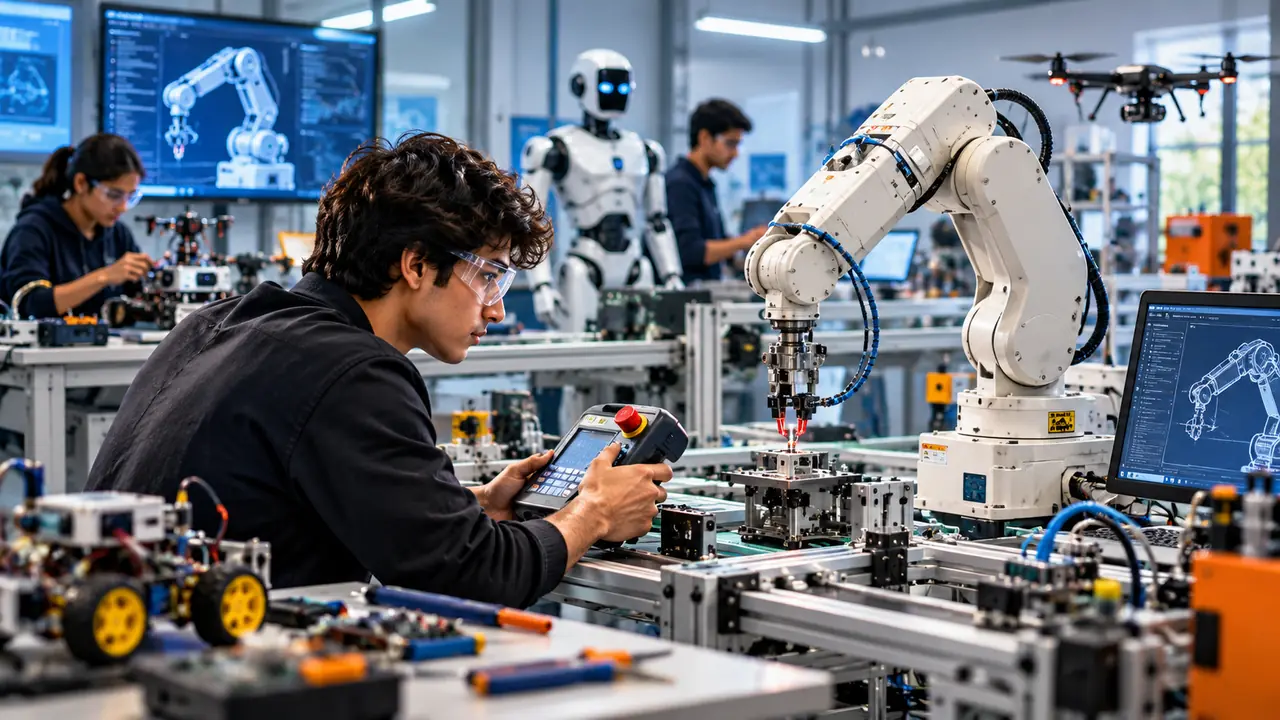
Robots are no longer only in factories and films. They assemble cars, assist surgeons, deliver packages, inspect pipelines, explore space and even clean homes. As industries automate, the people who design, build, program and maintain these machines are becoming increasingly important.
Robotics is one of the most exciting interdisciplinary careers, combining mechanical engineering, electronics and computer science. This guide explains the career paths, skills and education routes for students interested in robotics.
What is robotics?
Robotics is the design, construction, programming and operation of machines that can sense their environment, make decisions and act. Every robot combines three core elements:
That's why robotics teams bring together people with very different skills.
What are the main career paths in robotics?
| Role | What they do |
|---|---|
| Robotics engineer | Designs and builds complete robotic systems |
| Mechanical design engineer | Designs the physical structure and moving parts of robots |
| Electronics and control engineer | Designs circuits, sensors and control systems that make robots move precisely |
| Robotics software engineer | Writes the code that controls robots, often using tools like ROS (Robot Operating System) |
| Computer vision and AI engineer | Helps robots see, recognise objects and navigate |
| Automation engineer | Designs automated systems for factories and warehouses |
| Robotics technician | Installs, maintains and repairs robotic equipment |
| Research scientist | Develops new robotic technologies, often after a master's or PhD |
Where do robotics professionals work?
- Manufacturing and automotive, in assembly lines and industrial automation
- Healthcare, including surgical robots, rehabilitation devices and hospital automation
- Logistics and e-commerce, such as warehouse robots and delivery systems
- Agriculture, with drones, automated harvesting and crop monitoring
- Defence and space, including unmanned vehicles and space exploration
- Startups and research labs building new robotic products
What skills do you need for robotics?
- Physics and Maths, especially mechanics, calculus and linear algebra
- Programming, commonly Python and C++
- Electronics basics, such as circuits, sensors and microcontrollers like Arduino
- Mechanical design, including CAD software for 3D modelling
- Problem-solving and patience, because robots rarely work perfectly the first time
- Teamwork, since robotics projects combine many specialists
Robotics suits students with strong mechanical, spatial and logical aptitude who enjoy building and fixing things.
What is the education pathway to a robotics career?
In school (Classes 9 to 12)
- Choose PCM (Physics, Chemistry, Maths), ideally with Computer Science
- Start with beginner robotics kits, Arduino projects and basic coding
- Use your school's Atal Tinkering Lab or robotics club if available
- Take part in robotics competitions, science fairs and hackathons
After Class 12
- B.Tech or B.E. in Robotics and Automation, Mechatronics, Mechanical, Electronics, Electrical or Computer Science engineering, usually through JEE or state and university entrance exams
- Choose electives, projects and internships in robotics and automation
After graduation
An M.Tech or M.S. in robotics, mechatronics, control systems or AI can open research and advanced engineering roles, both in India and abroad. Countries with strong manufacturing and automation industries, such as Germany, are popular for robotics studies. See Study in Germany: Where Should You Start?
What is the future outlook for robotics?
As factories, hospitals, warehouses and farms automate, demand for people who can design, program and maintain robots is expected to grow. Robotics also combines physical and digital skills, which makes it one of the fields less likely to be replaced by AI alone. Read more in our guide to AI-proof careers.
Is robotics the right career for you?
Robotics may suit you if you enjoy taking things apart, building projects, coding and solving hands-on problems, and if you're comfortable with Physics and Maths. It may be less suitable if you dislike technical subjects or prefer purely people-focused work. A psychometric career assessment can show how well your aptitude and interests match engineering careers like robotics.
Summary
Robotics combines mechanical engineering, electronics, software and AI to create machines that sense, decide and act. Career paths include robotics, mechanical, electronics, software and automation engineering, across industries from manufacturing to healthcare and space. The usual route is PCM followed by an engineering degree in robotics, mechatronics or a related branch. Start early with kits, coding and competitions.
Career Captain’s assessments and counselling help you match your mechanical and technical aptitude to the right engineering branch and robotics career.
Book a counselling sessionFrequently asked questions
Which stream is best for a career in robotics?
PCM (Physics, Chemistry, Maths) is essential for robotics engineering, ideally with Computer Science.
Which engineering branch should I choose for robotics?
Robotics and Automation, Mechatronics, Mechanical, Electronics, Electrical and Computer Science engineering can all lead to robotics careers. Choose based on whether you enjoy mechanical design, electronics or software most.
Do I need coding for robotics?
Yes. Most robotics roles involve programming, commonly in Python and C++. Even mechanical and electronics engineers benefit from coding skills.
How can school students start learning robotics?
Start with beginner robotics kits and Arduino projects, learn basic coding, use your school's tinkering lab or robotics club, and take part in robotics competitions.
Is robotics a good career for the future?
Demand is expected to grow as industries automate. Because robotics combines physical and digital skills, it is also less likely to be fully automated by AI.