
Careers in Semiconductors and Chip Design
The chips behind phones, cars and AI, and the growing careers behind them as India builds its semiconductor industry.
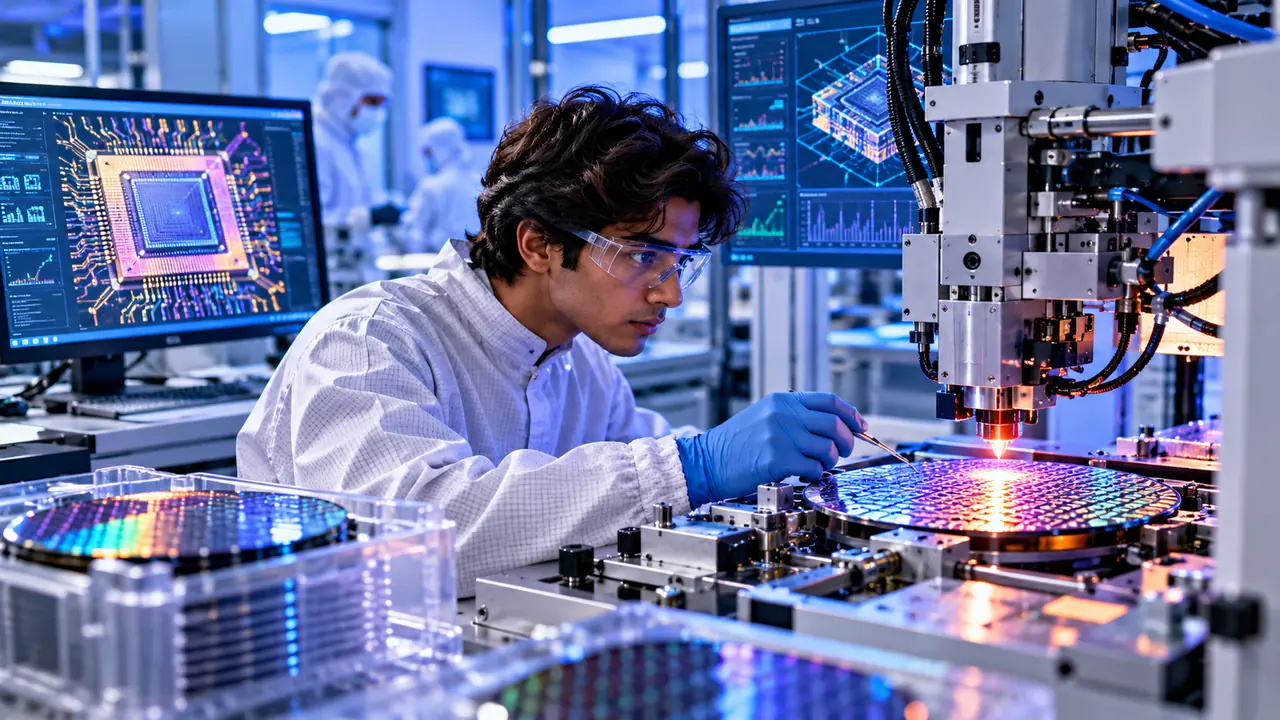
Semiconductor chips are the hidden brains of modern life. They power your phone, laptop, car, washing machine, hospital equipment, satellites and the data centres that run AI. Without chips, almost nothing digital works.
For a long time, most chip manufacturing happened in a handful of countries, even though many chips were designed by engineers in India. That's now changing, and it's creating exciting new career opportunities for Indian students. This guide explains how the industry works, the careers it offers and how to prepare.
How does the chip industry work?
Making a chip involves several stages, each with its own careers:
| Stage | What happens |
|---|---|
| Design | Engineers design the chip's circuits and architecture using specialised software |
| Fabrication (the “fab”) | Chips are manufactured on silicon wafers in ultra-clean facilities using highly advanced equipment |
| Assembly, testing and packaging (ATMP/OSAT) | Chips are cut, packaged, tested and prepared for use in products |
| Equipment and materials | Companies supply the machines, chemicals and materials that make chipmaking possible |
Why is this a big opportunity in India right now?
India has long been a major centre for chip design, with many global semiconductor companies running large design teams in cities such as Bengaluru, Hyderabad and Noida. Now India is building its manufacturing base too, under the India Semiconductor Mission.
Several assembly and testing plants have started operating, including Micron's facility at Sanand in Gujarat, inaugurated in February 2026. India's first large chip fabrication plant, a Tata Electronics project at Dholera in Gujarat, is under construction, with first production targeted from late 2026. A growing industry needs many more trained engineers and technicians, from design to the factory floor.
What are the main career paths?
| Role | What they do |
|---|---|
| VLSI design engineer | Designs the digital circuits inside chips |
| Verification engineer | Tests chip designs thoroughly before manufacturing to catch errors |
| Physical design engineer | Plans how circuits are laid out on the chip |
| Analog and mixed-signal engineer | Designs circuits for power, sensors and communication |
| Process engineer | Develops and improves manufacturing steps inside the fab |
| Equipment engineer | Installs, maintains and optimises complex fab machinery |
| Test and packaging engineer | Ensures chips are packaged correctly and work reliably |
| Semiconductor technician | Operates and supports equipment in fabs and assembly plants |
What skills do you need?
- Strong Physics and Maths, especially electricity, electronics and calculus
- Digital and analog electronics
- Hardware description languages and design tools for design roles
- Materials science and chemistry for fabrication and process roles
- Attention to detail and patience, since chips are built at microscopic scales with no room for error
- Problem-solving and teamwork
This field suits students with strong logical, numerical and spatial aptitude who enjoy Physics and electronics.
What is the education pathway?
In school (Classes 9 to 12)
- Choose PCM (Physics, Chemistry, Maths). Physics is especially important
- Explore electronics through kits, Arduino projects or your school's tinkering lab
- Build strong foundations in electricity and circuits
After Class 12
- B.Tech or B.E. in Electronics and Communication, Electrical and Electronics, or Electronics and VLSI, usually through JEE or state and university entrance exams
- B.Tech in Materials, Chemical Engineering or Engineering Physics for fabrication and process roles
- Diploma courses in electronics for technician roles in fabs and assembly plants
After graduation
An M.Tech or M.S. in VLSI design, microelectronics or semiconductor technology is common for design and research roles. Strong programmes exist in India and abroad, including in countries with established chip industries. See our guide to AI-proof careers abroad.
Is chip design a good career for the future?
Chips are needed for AI, electric vehicles, 5G, defence and nearly every electronic product, and many countries, including India, are investing heavily in building their own chip industries. That makes semiconductors one of the most strategically important fields of the coming decades.
Is a semiconductor career right for you?
It may suit you if you enjoy Physics and electronics, like precise, detailed work and are excited by deep technology. It may be less suitable if you dislike Physics and Maths. A psychometric career assessment can show how well your aptitude and interests fit careers in electronics and chip design.
Summary
Semiconductor chips power almost every modern device. Careers span chip design, fabrication, testing and packaging, and equipment. India is already strong in chip design and is now building manufacturing plants, creating new opportunities. The usual route is PCM followed by an electronics, electrical, materials or VLSI-focused degree, with diplomas available for technician roles. Start early by exploring electronics and building strong Physics foundations.
Career Captain’s assessments and counselling help you check your aptitude for electronics and plan the right stream, engineering branch and specialisation.
Book a counselling sessionFrequently asked questions
Which stream is needed for a career in semiconductors?
PCM (Physics, Chemistry, Maths) is needed for engineering roles in semiconductors. Physics is especially important.
Which engineering branch is best for chip design?
Electronics and Communication, Electrical and Electronics, or Electronics and VLSI engineering are the most common routes into chip design.
What is VLSI?
VLSI stands for Very Large Scale Integration. It refers to designing chips that contain millions or billions of tiny transistors, and it's the core of chip design careers.
Is India making its own chips?
India has long been a major centre for chip design. Several assembly and testing plants have started operating, and India's first large fabrication plant at Dholera in Gujarat is under construction, with first production targeted from late 2026.
Can diploma students work in the semiconductor industry?
Yes. Fabrication and assembly plants need trained technicians, and diploma courses in electronics can lead to these roles.