
IELTS vs PTE vs TOEFL: Which Test Should You Take?
Most universities abroad ask for an English test score, and IELTS, PTE and TOEFL are the most common. Here is how they differ and how to choose the one that suits you.
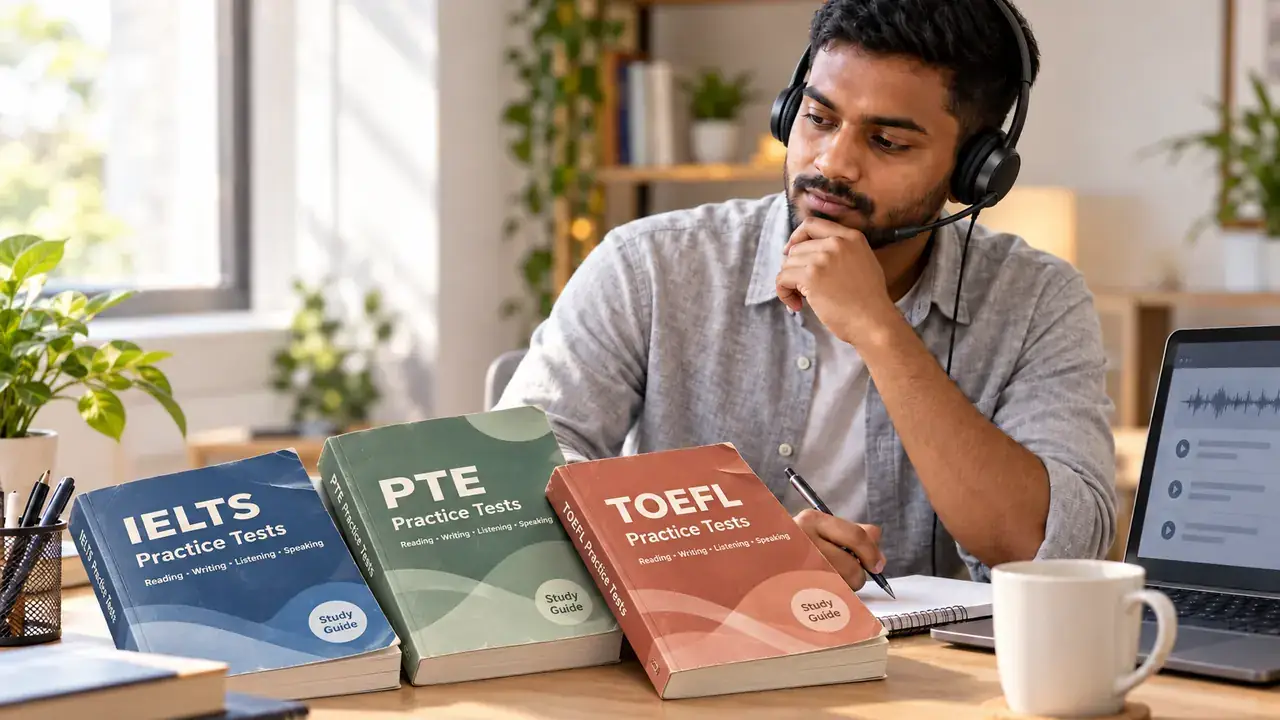
If you are planning to study abroad, you will almost certainly need to prove your English proficiency. The three most widely used tests are IELTS, PTE Academic and TOEFL iBT. All three test reading, writing, listening and speaking, but they do it in different ways, and the right choice can make a real difference to your score and your stress levels.
First rule: check what is accepted
Before comparing formats, check which tests are accepted by the universities on your list and, where relevant, for your visa. Acceptance varies by country, institution and even course. Choosing a test that is not accepted is a costly mistake. Once you know which tests are acceptable, choose the one that best suits your strengths.
IELTS at a glance
IELTS Academic is widely accepted for study around the world. It can be taken on paper or on a computer, depending on the test centre. A key feature is the speaking test, which is a face-to-face conversation with an examiner. Scores are given as bands on a nine-point scale.
IELTS often suits students who are comfortable speaking to a person and prefer a more conversational format.
PTE Academic at a glance
PTE Academic is fully computer-based, including speaking, which is recorded through a microphone rather than with an examiner. Scoring is automated. Several tasks combine skills, for example listening and then writing or speaking.
PTE often suits students who are comfortable with computers, type well, and prefer speaking to a microphone rather than to a person.
TOEFL iBT at a glance
TOEFL iBT is computer-based and is especially well known among universities in the USA, while also being accepted in many other countries. Speaking responses are recorded, and tasks often use academic, university-style content such as lectures and campus conversations.
TOEFL often suits students applying mainly to US universities and those comfortable with academic reading and listening.
Side-by-side comparison
| IELTS Academic | PTE Academic | TOEFL iBT | |
|---|---|---|---|
| Format | Paper or computer | Computer | Computer |
| Speaking | Face to face with an examiner | Recorded into a microphone | Recorded into a microphone |
| Scoring | Bands on a nine-point scale | Automated scoring | Scaled score |
| Well suited to | Students who prefer conversation | Confident computer users | Students targeting the USA |
Test formats, lengths and rules are updated from time to time. Always check the official website of the test before you book.
How to choose: five questions
- Which tests do my universities, and my visa if relevant, accept?
- Do I prefer speaking to a person or to a microphone?
- Am I comfortable typing quickly and working on a computer?
- How soon do I need my results?
- Are there convenient test dates and centres near me?
Taking a free practice test for each option is one of the best ways to find out which format suits you.
Preparation tips that work for every test
- Learn the test format thoroughly before you start practising
- Take a timed mock test early to find your weak areas
- Practise every day, with extra time on your weakest skill
- Read and listen to English content regularly, not just test material
- Book your test with enough time to retake it before application deadlines if needed
Summary
IELTS, PTE and TOEFL all measure English proficiency, but they differ in format, speaking style and scoring. Start by checking which tests your universities and visa accept, then choose the format that suits your strengths, practise with timed mock tests and book early. For help planning your applications, see our study abroad services, or read our guides to studying in Canada, the USA and Australia.
Career Captain helps students plan their study abroad journey, from choosing the right test and country to building strong applications.
Book a counselling sessionFrequently asked questions
Which is easier: IELTS, PTE or TOEFL?
None is easier for everyone. It depends on your strengths. Students who prefer conversation often like IELTS, while confident computer users often prefer PTE or TOEFL.
Is PTE accepted everywhere IELTS is accepted?
Not always. Acceptance varies by country, university and course. Always check the requirements of your chosen universities and, where relevant, your visa.
Is TOEFL only for the USA?
No. TOEFL is especially well known in the USA but is accepted by many universities in other countries too. Check each university's requirements.
How long are English test scores valid?
Scores are usually valid for a limited period. Check the current validity rules on the official test website and your universities' requirements.
How much preparation time do I need?
It depends on your current level and target score. Take a timed mock test first, then plan your preparation around your weakest areas.