
Careers in Space Technology
Satellites, launch vehicles and India’s fast-growing space sector: the careers, skills and pathways to get there.
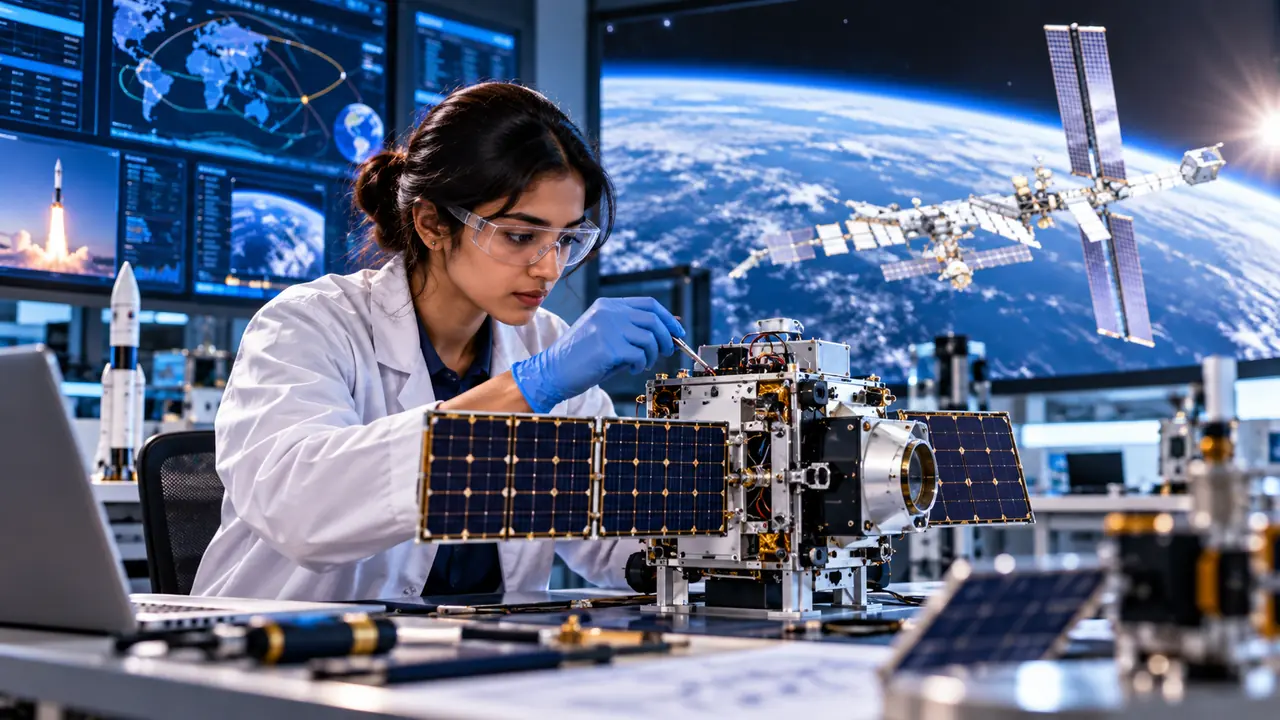
For many students, the moment Chandrayaan-3 touched down near the Moon's south pole in 2023 was unforgettable. It showed the world, and a generation of young Indians, that India can compete at the frontier of space exploration. Many of those students now wonder: could I work in space too?
The good news is that space careers are no longer limited to a small number of government scientists. India's space sector has opened up to private companies and startups, creating new opportunities in engineering, science, software and business. This guide explains the career paths, skills and education routes into space technology.
What does the space sector include?
| Area | What it involves |
|---|---|
| Launch vehicles | Designing and building rockets that carry satellites and spacecraft into space |
| Satellites | Building satellites for communication, navigation, weather, Earth observation and defence |
| Space science and exploration | Missions to study the Moon, planets, the Sun and the universe |
| Ground systems and operations | Controlling missions, tracking satellites and receiving data on Earth |
| Space applications | Using satellite data for agriculture, disaster management, mapping, climate and navigation |
| Human spaceflight | Preparing systems and missions to carry astronauts, such as India's Gaganyaan programme |
What are the main career paths?
| Role | What they do |
|---|---|
| Aerospace engineer | Designs rockets, spacecraft and their structures |
| Propulsion engineer | Develops rocket engines and propulsion systems |
| Avionics and electronics engineer | Builds the electronic, navigation and control systems on spacecraft |
| Satellite systems engineer | Designs and integrates satellites and their payloads |
| Space software engineer | Writes flight software, simulation and ground control software |
| Remote sensing and GIS specialist | Analyses satellite images and data for real-world applications |
| Space scientist or astrophysicist | Studies planets, stars and the universe, usually after a PhD |
| Mission operations specialist | Monitors and controls spacecraft during missions |
The growing commercial space industry also needs people in business, law, policy and finance, which opens doors for students beyond engineering.
Why is now an exciting time for space careers in India?
India's space programme has a long record of cost-effective, successful missions, from satellite launches to lunar and solar missions. In recent years, the government has opened the sector to private companies, and a growing number of Indian space startups now build rockets, satellites and satellite-data services. This means space careers are now available at ISRO and other research organisations, at private space companies and startups, and in industries that use satellite data.
What skills do you need?
- Strong Physics and Maths, especially mechanics, calculus and electromagnetism
- Engineering fundamentals in your chosen branch
- Programming and simulation skills
- Precision and attention to detail, since small errors can end a mission
- Teamwork and patience, since space projects involve large teams and long timelines
Space careers suit students with strong logical, numerical and spatial aptitude and a deep curiosity about the universe.
What is the education pathway?
In school (Classes 9 to 12)
- Choose PCM (Physics, Chemistry, Maths), ideally with Computer Science
- Take part in science olympiads, astronomy clubs, model rocketry or satellite-themed competitions
- Follow space missions and learn basic programming
After Class 12
- B.Tech or B.E. in Aerospace, Mechanical, Electronics, Electrical, Computer Science or Engineering Physics
- Specialised institutes such as the Indian Institute of Space Science and Technology (IIST) in Thiruvananthapuram offer space-focused programmes
- B.Sc. in Physics or Mathematics for students interested in space science and research
After graduation
Many space roles value an M.Tech, M.S. or PhD, especially in research and specialised engineering. Space scientists and astrophysicists usually need a PhD. Strong programmes are available in India and abroad.
Is space technology right for you?
It may suit you if you love Physics and Maths, dream about space, enjoy solving complex technical problems and are patient with long, detailed projects. It's a competitive field, so strong fundamentals and persistence matter. A psychometric career assessment can show how well your aptitude fits engineering and science careers like these.
Summary
Space technology includes launch vehicles, satellites, exploration, ground operations and space applications. Careers range from aerospace and propulsion engineering to software, remote sensing and space science. The usual path is PCM followed by an engineering or science degree, often with higher studies. With India's space sector opening to private companies, opportunities are growing at ISRO, startups and satellite-data businesses.
Career Captain’s assessments and counselling help you check your aptitude for engineering and science and plan the right stream, degree and path into space careers.
Book a counselling sessionFrequently asked questions
Which stream is needed for a career in space technology?
PCM (Physics, Chemistry, Maths) is essential for engineering and science careers in space. Computer Science is also useful.
Can I work at ISRO after engineering?
Yes. ISRO recruits engineers and scientists from several branches, including mechanical, electronics, electrical and computer science. Recruitment is competitive and based on exams and academic performance.
Is aerospace engineering the only route into space careers?
No. Mechanical, electronics, electrical, computer science and engineering physics graduates also work in the space sector, as do physicists, mathematicians and data specialists.
Are there space jobs outside ISRO in India?
Yes. India's space sector has opened to private companies, and a growing number of startups build rockets, satellites and satellite-data services.
Do I need a PhD to work in space?
Not for most engineering roles. Space scientists and researchers usually need a PhD, while many engineering roles need a bachelor's or master's degree.